 It feels like the Mavericks just won the entire championship with the way this series went. Go Mavs!
Monday, May 22, 2006
How 'Bout Them Mavs!
It feels like the Mavericks just won the entire championship with the way this series went. Go Mavs!

Sunday, May 21, 2006
Dr. Gene Scott: Pastor, Scholar, Cigar Aficionado
( I am posting this mostly for the benefit of my wife who has never had the pleasure of viewing a Gene Scott television show.) Just thought I would post a little something on one of the true televangelists ever to grace a T.V. screen: Gene Scott. He's was a "pastoral teacher," scholar (with a Ph.D. in education), philanthropist, vineyard owner and lover of fine wines...well, you can read the rest here.
I'm not selling forty-pound Bibles, or water from Jordan, or 4,000 plastic crosses made by the Japanese and sold to Arabs. I don't send out 'healing cloths' or tear up my shirt. I say: what's what I've done worth? Whatever the meal I've fed you is worth, pay up. I'm not trying to save anybody. I think if you reject Christianity, you should do it intelligently.
 -- Gene Scott (1929-2005)
 I am posting this mostly for the benefit of my wife who has never had the pleasure of viewing a Gene Scott television show.) Just thought I would post a little something on one of the true televangelists ever to grace a T.V. screen: Gene Scott. He's was a "pastoral teacher," scholar (with a Ph.D. in education), philanthropist, vineyard owner and lover of fine wines...well, you can read the rest here.
I'm not selling forty-pound Bibles, or water from Jordan, or 4,000 plastic crosses made by the Japanese and sold to Arabs. I don't send out 'healing cloths' or tear up my shirt. I say: what's what I've done worth? Whatever the meal I've fed you is worth, pay up. I'm not trying to save anybody. I think if you reject Christianity, you should do it intelligently.
 -- Gene Scott (1929-2005)
Saturday, May 20, 2006
Saddam Hussein: The Next Salman Rushdie?
 Apparently Saddam has always had a penchant for writing novels. Seriously. This latest installment of his was supposedly written just before the U.S. invaded Iraq in 2003. It has just been published in Japan. Those crazy Japanese. You can read about it here.
Wednesday, May 17, 2006
The Da Vinci Code secret is out: critics hate it
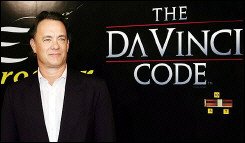 I haven't been a very vocal critic about The Da Vinci Code: not because I am a latent fan of Dan Brown's fiction but because I have not had time to read any of it. Nevertheless, I find this article from Reuters interesting. Da Vinci has apparently gone over like a lead balloon with some critics at Cannes. Here's an excerpt:
At a screening late on Tuesday in Cannes, members of the audience laughed at the thriller's pivotal moment, and the end of the $125 million picture was greeted with stony silence.
Here's another article with these comments:
Other critics said the two and a half hour film was confusing to those who hadn't read the book.
"People were confused, there was no applause, just silence," said Margherita Ferrandino from the Italian television Rai 3.
"I have only read half the book, and then I got bored. It's terrible," she added.
"It was really disappointing. The dialogue was cheesy. The acting wasn't too bad, but the film is not as good as the book," added Lina Hamchaoui, from British radio IRN.
Tuesday, May 16, 2006
Muslims and Catholics Together

 Catholic Christians in India have threatened to stage a large protest at the premiere of The Da Vinci Code and consequently have forced a temporary halt on the opening of the film. Muslims have even joined in.
In India, complaints against the film forced the government on Tuesday to put a temporary hold on the release of “The Da Vinci Code,” in order to address concerns before the film is opened to the public. Prior to the decision, several Catholic groups threatened to stage street demonstrations and even to shut down cinema halls screening the film. Joining in the call on Monday was the All-India Sunni Jamiyat-ul-Ulema, a powerful organization of Indian Islamic clerics, which promised to help Christian groups launch protests if the authorities did not ban the screening of the film. The clerics said "The Da Vinci Code" is blasphemous as it spreads lies about Jesus, who the Koran recognizes as a prophet.
You can read the rest here.
Sunday, May 07, 2006
Bible literalism 'pagan superstition'?
 Vatican astronomer Guy Consolmagno says believing God created the universe in six days is a form of "pagan superstition."
Consolmagno told the Scotsman the idea that religion and science are competing principles is a "destructive myth."
Read the rest here.
Saturday, May 06, 2006
Love and Marriage
 I found this great quotation that Anthony Esolen posted at the Mere Comments blog on April 29. It's from Sir Philip Sydney: I know him for a work called A Defense of Poetry. I also know of him because C.S. Lewis was well acquainted with his work. The quotation is below, and you can read Esolen's musings on it here.
"A happy couple: he joying in her, she joying in herself, but in herself, because she enjoyed him: both increasing their riches by giving to each other; each making one life double, because they made a double life one; where desire never wanted satisfaction, nor satisfaction ever bred satiety: he ruling, because she would obey, or rather because she would obey, she therein ruling." From Sir Philip Sidney, Arcadia (1593).
Friday, April 28, 2006
T.V.
 I have an ambivalent attitude toward TV. I watched TONS of it as a kid and read little. My wife was just the opposite: she looks at me as though I'm speaking a foreign language when I begin to reminisce about my TV viewing in the '80's. At times, I hate the TV--with all its commercials and mind-numbing flickering--but then, at other times, despite the flaws it possesses as a medium, there are some things I really enjoy watching. Here's a cleverly written and insightful article expressing some of these very same sentiments. In fact, here's as snippet:
Of course, TV has always been mostly awful. “Boob tube” did not begin as an anatomical observation. The myth persists of a Golden Age of Television in the 1950s, but the blurry surviving kinescoped evidence yields a baser metal. Way back in May 1961, Newton Minow, chairman of the Federal Communications Commission, called TV “a vast wasteland.” Well, the landscape is a lot vaster 44 years later, and still wasted, but how could it not be? TV never stops any more; there’s just too much of it. In the late 1940s, a station played “The Star Spangled Banner” by 10 p.m. and signed off for the night. The citizenry rested—or read or did their bit for the baby boom. There’s not enough talent even in today’s fame-crazed United States to keep TV interesting all the time. Remember: Most books are not worth reading either. And not every play took a prize in old Athens; the relatively few that survive by no means represent the lot that did not.
And I had to include this one just because he mentions one of my favorite shows, King of the Hill...
King of the Hill dates from 1997, but it’s never had the breakout success it deserves, which may be a good thing. Fame hasn’t gone to its head, as happened with The Simpsons. (Fox routinely sacrifices Hill on Sunday evenings to the gods of interminable football games.) The series has stayed steadily on track and low-key hilarious, at once a send-up and an affirmation of red-state America values. The Hill family of Arlen, Texas, may shop at the big-box Mega-Lo Mart, but they’re TV royalty: levelheaded patriarch Hank (the anti-Homer Simpson), purveyor of propane and propane accessories; his wife, Peggy, a substitute high school teacher, sometimes of Spanish, who has to wing it after hola; and their ample, affable, and fitfully adolescent 13-year-old son, Bobby, of Tom Landry Middle School. Good people all, who deserve a more compliant world.
Wednesday, April 26, 2006
Christianity and the Arts
 I have been leading a class at my church through C.S. Lewis' Screwtape Letters. I found this short article called "TheImportance of the Arts to Christianity" by Louis Markos. It's very insightful. Markos is a Lewisian, and I found it here. Here it is:
THE IMPORTANCE OF THE ARTS TO CHRISTIANITY
by Louis Markos, Houston Baptist University
1. Through a proper use of the arts, we must heal the enlightenment split between religion and science, art and technology, values and facts, myth and history, fiction and fact, emotional and rational, intuition and logic, revelation and reason, secular and sacred, poetry and doctrine. We need a re-synthesis, one that will allow us to worship God with our minds and hearts. We need to use the arts to heal what T. S. Eliot called “the dissociation of sensibility” that set in c. 1800. A proper use of the arts may even help us to re-integrate the modern Christian divide between a too-rigid focus on systematic theology and an overly-emotional emphasis on spiritual gifts.
2. We need the arts to make Christian theology come real. Art comes closer than systematic theology at expressing and capturing the mystery inherent in the Trinity. Art, in bringing together the abstract and the particular, the universal and the concrete points to the Incarnation—the central belief that Jesus was FULLY Man and FULLY God. We can learn from the Eastern Orthodox focus on icons as proclaimers of the Word made Flesh. The Incarnation baptized physical matter as a fit receptacle for divine meaning and presence. We need not be iconoclasts or fear representations of holy subjects (as do the Muslims and as did the Jews)
3. The producing, absorbing, and interpreting of the arts exercises the mind to under-stand the many levels of meaning in Scripture. Augustine and Aquinas both felt that God purposely made the Bible difficult so that we would have to wrestle with it (Bible is not stream-lined, not all slick packaging). A full wrestling with the arts and the stories that underlie them helps us to perceive and to engage sacred history. It helps us to see and understand that God works THROUGH history; Bible is mostly told from man’s perspective. (Dream of the Giant; Dante forces us to learn history.)
4. We must be salt and light in the world; we must engage our culture through the arts. The arts speak to people on a deep level; they form people’s opinions and attitudes in a way that is often not seen. The battle is often won through images, for it is around images that people often hang their beliefs and goals. The influence of rap, heavy metal and MTV is far more harmful than anyone gives it credit for.
5. The arts are vital to the artist, for we MUST use our gifts (Matt 25). Even if no one reads/hears our work, through the very fact that we produced it, we praise God. We must strive for excellence—not just be good enough to sing on Sunday morning.
6. The arts help us to perceive and/or build connections everywhere. By so doing, they allow us: a) to rebuild the sympathetic universe that the medievals saw and that Dante embodied most fully; 2) to see that Christ fulfills not only the Jewish Law/Prophets but all the deepest philosophical, theological, and aesthetic yearnings of mankind; 3) to be better evangelists and apologists through an ability to re-incarnate the Gospel in a variety of different cultures; 4) to praise God through a symphony of voices.
Louis Markos, Houston Baptist Univ., lmarkos@hbu.edu,
http://fc.hbu.edu/~lmarkos
Thursday, April 20, 2006
Another from The Daily Gospel
 The early church doctors' and fathers' poetic understanding of Scripture and salvation history is beautiful:
Commentary of the day : Saint Peter Chrysologus (around 406 – 450), Bishop of Ravenna, Doctor of the Church Sermon 81
“Jesus came and stood before them. ‘Peace be with you.’”
Rebellious people had chased peace from the earth… and thrown the world into its primordial chaos… Among the disciples as well, war was waging; faith and doubt fought furious assaults on one another… Where a storm was raging, their hearts could find no peaceful harbor, no calm port. At the sight of that, Christ, who plumbs the hearts, who commands the winds, who is master over the tempests and who with a simple sign changes the storm into a serene sky, strengthened them with his peace, saying: “Peace be with you! It is I; fear not. It is I who was crucified, who was dead, who was buried. It is I, your God become man for you. It is I. Not a spirit clothed with a body, but truth itself become man. It is I, the living one among the dead, who have come from heaven to the heart of hell. It is I before whom death fled, whom hell feared. In its terror, hell proclaimed me to be God. Do not be afraid, Peter, you who denied me, nor you, John, who fled, nor all of you who abandoned me, who thought of nothing but betraying me, who do not yet believe in me, even though you see me. Do not be afraid, it really is I. I have called you with grace, I have chosen you with forgiveness, I have upheld you with my compassion, I have carried you in my love, and I am taking you today solely because of my kindness.”
Deconstructing Lewis Part 3
I'm having to backtrack a bit on the last post. I've come to a better understanding of Kathryn Lindskoog (now deceased) and her position in the wars between her and the estate of C.S. Lewis, with its literary advisor, Walter Hooper. This article explains the whole thing. While I still have my doubts about Hooper, I have come to understand Lindskoog a little better. Her zeal for Lewis and his works was admirable, but it seems that it often led her to hasty judgments and conclusions.
Monday, April 17, 2006
Deconstructing Lewis Part 2
Last week, I had a beef with Adam Gopnik's critique of Alan Jacob's The Narnian, which was published in the The New Yorker a few months ago. Gopnik relies heavily on A.N. Wilson's biography of Lewis. The picture Wilson paints of Lewis lack credibility: just read this article by Kathryn Lindskoog where she not only highlights Wilson's numerous factual errors but also reveals the agenda that is at back of those errors.
Friday, April 14, 2006
Good Friday
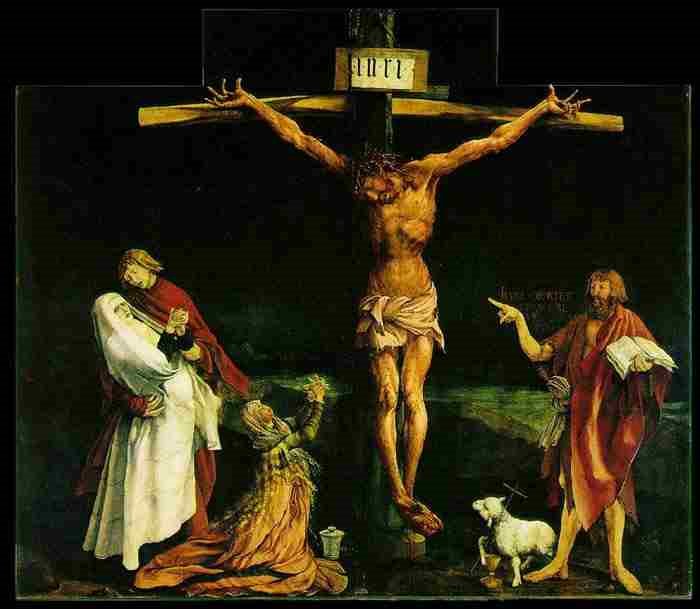
God, who needs nothing, loves into existence wholly superfluous creatures in order that He may love and perfect them. He creates the universe, already foreseeing--or should we say "seeing"? there are no tenses in God--the buzzing cloud of flies about the cross, the flayed back pressed against the uneven stake, the nails driven through the mesial nerves, the repeated incipient suffocation as the body droops, the repeated torture of back and arms as it is time after time, for breath's sake, hitched up. If I may dare the biological image, God is a "host" who deliberately creates His own parasites; causes us to be that we may exploit and "take advantage of" Him. Herein is love. This is the diagram of Love Himself, the inventor of all loves. -- C.S. Lewis
Thursday, April 13, 2006
George Herbert's "The Sacrifice"
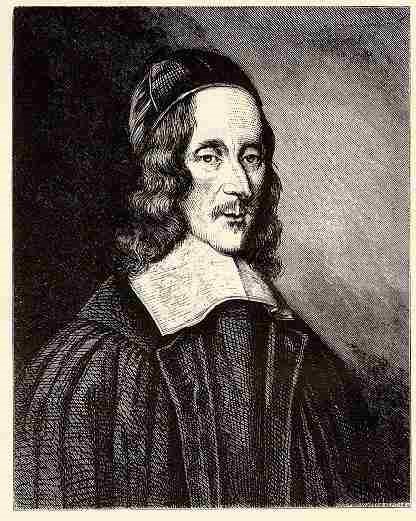
Anthony Esolen posted this today at the Mere Comments blog. It's a very good poem and by the author who wrote the poem from which the name of this blog comes.
....My cross I bear myself, until I faint:
Then Simon bears it for me by constraint,
The decreed burden of each mortal Saint:
Was ever grief like mine?
O all ye who pass by, behold and see:
Man stole the fruit, but I must climb the tree;
The tree of life to all, but only me:
Was ever grief like mine?....
Lo, here I hang, charged with a world of sin,
The greater world o' th' two; for that came in
By words, but this by sorrow I must win:
Was ever grief like mine?....
But, O my God, my God! why leav'st thou me,
The son, in whom thou dost delight to be?
My God, my God ----
Never was grief like mine.
From George Herbert, "The Sacrifice" (1633)
Maundy Thursday: The Institution of the Eucharist
This is an appropriate quotation from C.S. Lewis for today, Maundy Thursday:
"I do not know and can't imagine what the disciples understood Our Lord to mean when, His body still unbroken and His blood unshed, He handed them the bread and wine, saying they were His body and blood...I find no difficulty in believing that the veil between the worlds [heaven and earth], nowhere else (for me) opaque to the intellect, is nowhere else so thin and permeable to divine operation. Here a hand in the hidden country touches not ony my soul but my body. Here the prig, the don, the modern, in me have no privilege over the savage or the child...The command, after all, was Take, eat: not Take, understand. Particularly, I hope I need not be tormented by the question 'What is this?'--this wafer, this sip of wine. That has a dreadful effect on me. It invites me to take 'this' out of its holy context and regard it as an object among objects, indeed as part of nature. It is like taking a red coal out of the fire to examine it: it becomes a dead coal." (from Letters to Malcolm, Ch.19)
See the previous post (below) for another good meditation for today in the church calendar.
"I do not know and can't imagine what the disciples understood Our Lord to mean when, His body still unbroken and His blood unshed, He handed them the bread and wine, saying they were His body and blood...I find no difficulty in believing that the veil between the worlds [heaven and earth], nowhere else (for me) opaque to the intellect, is nowhere else so thin and permeable to divine operation. Here a hand in the hidden country touches not ony my soul but my body. Here the prig, the don, the modern, in me have no privilege over the savage or the child...The command, after all, was Take, eat: not Take, understand. Particularly, I hope I need not be tormented by the question 'What is this?'--this wafer, this sip of wine. That has a dreadful effect on me. It invites me to take 'this' out of its holy context and regard it as an object among objects, indeed as part of nature. It is like taking a red coal out of the fire to examine it: it becomes a dead coal." (from Letters to Malcolm, Ch.19)
See the previous post (below) for another good meditation for today in the church calendar.
Maundy Thursday: Love One Another As I Have Loved You
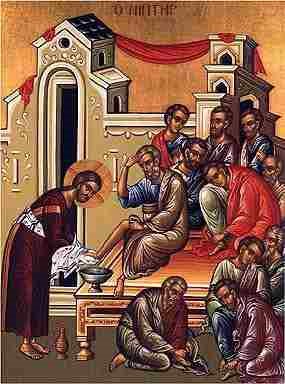
Here's a wonderful meditation from Guerric of Igny (around 1080 – 1157), Cistercian abbot. 1st Sermon for Palm Sunday from www.dailygospel.org
“He had loved his own in this world, and would show his love for them to the end.”“Your attitude must be that of Christ.” … “He was in the form of God,” equal to God by nature, since he shared in God’s power, God’s eternity and God’s very being… He did the job of a servant “by humbling himself, obeying his Father even to death, death on a cross.” (cf. Phil 2:5-8) One might consider it to be trivial that, as God’s Son and his equal, he served his Father as a servant. More than that, he served his own servant more than any other servant. For the human being had been created to serve his Creator. What could be more just for you than to serve him who made you, without whom you would not be? And what could be more blest than to serve him, since to serve him is to reign? But the human being said to his Creator: “I will not serve.” (Jer 2:20)Then the Creator said to the human being: “So I will serve you! Go sit down at the table; I will serve. I will wash your feet. Rest. I will take your pains upon myself; I will carry your weakness… If you grow tired or are burdened, I will carry you, you and your burden, so as to be the first to fulfill my law: ‘Carry one another’s burdens’ (Gal 6:2)… If you are hungry or thirsty…, here I am, ready to be sacrificed so that you might eat my flesh and drink my blood… If you are taken into captivity or if you are sold, here I am… Redeem yourself by paying the ransom you will get from me. I give myself as ransom… If you are sick, if you fear death, I will die in your place, so that from my blood you can make for yourself a life-giving remedy…”O my Lord, what a price you paid to ransom my useless service!… What a way you had, full of love, of gentleness and of kindness, to win back and submit this rebellious servant by triumphing over evil through good, by confounding my pride with your humility, by filling this ungrateful person with your kindness! This! This is how your wisdom triumphed.
Wednesday, April 12, 2006
Deconstructing Lewis?
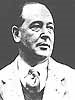 This is old news, but I think it's worth bringing up...I just found this review of Alan Jacob's book The Narnian, which came out just before the movie this past Christmas. This review is by New Yorker critic Adam Gopnik. I found his review to be a poor piece of journalism. I say this not because of the dirt he uncovers on Lewis (Lewis doesn't hide his dirt, and what he does hide is out of a sense of propriety), which comes from A.N. Wilson's biography of Lewis' life (one that relies on the "hermeneutic of suspicion"). I say this because Gopnik's write up is dripping with a preunderstanding of Lewis that is reactive to Lewis' reception in America by conservative Christians. It's so reactive that it gets the most basic of details wrong. Consequently, his review is so biased with a desire to deconstruct Lewis that it fails to offer a fair reading.
Here's an example:
Converted to faith as the means of joy, however, Lewis never stops to ask very hard why this faith rather than some other. His favorite argument for the truth of Christianity is that either Jesus had to be crazy to say the things he did or what he said must be true, and since he doesn’t sound like someone who is crazy, he must be right.
Compare this to a letter from Lewis to Sheldon Vanauken published in Vanauken's book A Severe Mercy (pp.89-90). This is a long quotation but worth reading:
What you really start with [in the history of religion] is ritual, myth, and mystery, the death and return of Balder or Osiris, the dances, the initiations, the sacrifices, the divine kings. Over against that are the Philosophers, Aristotle or Confucius, hardly religious at all. The only two systems in which the mysteries and the philosophies come together are Hinduism and Christianity: there you get both Metaphysics and cult...That is why my first step was to be sure that one or the other of these [Hinduism or Christianity] had the answer. For the reality can't be one that appeals either only to savages or only to high brows. Real things aren't like that (e.g. matter is the first most obvious thing you meet--milk, chocolates, apples, and also the object of quantum physics). There is no question of just a crowd of disconnected religions. The choice is between (a.) The materialist world picture: wh. I can't believe (b.) The real archaic primitive religions: wh. are not moral enough (c.) The (claimed) fulfillment of these in Hinduism (d.) The claimed fulfillment of these in Christianity. But the weakness of Hinduism is that it doesn't really join the two strands...It is only Christianity wh. compels a high brow like me to partake in a ritual blood feast, and also compels a central African convert to attempt an enlightened universal code of ethics.
How one can say that Lewis really did not think through the "Liar, Lunatic or Lord" argument and can imply that he used it as a catchy word device to sum up his faith is beyond me. Moreover, Lewis did, in fact, look into Hinduism before converting to the Church (as the quotation above implies).
I am not for enshrining Lewis in the stain glass of churches--and undoubtedly, Lewis would not have wanted anything like this either--but at least give him a fair reading and be more careful in your journalism, Mr. Gopnik.
Collect for Wednesday
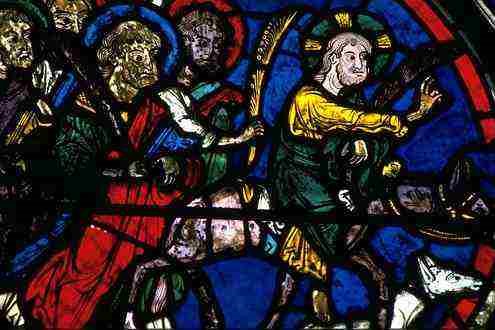
This is the collect* for Wednesday of Holy Week taken from the Book of Common Prayer:
O Lord God, whose blessed Son our Savior gave his back to the smiters and hid not his face from shame: Grant us grace to take joyfully the sufferings of the present time, in full assurance of the glory that shall be revealed; through the same thy Son Jesus Christ our Lord, who liveth and reigneth with thee and the Holy Spirit, one God, for ever and ever. Amen.
* Collect: From the Latin word collecta, meaning "assembly." The word is normally used to refer to the prayer near the beginning of the Eucharist that precedes the lessons. The collect was supposedly designed to "collect" the thoughts of the lessons and bind the thoughts together, back in the days when only one lesson and a Gospel were read. A collect is actually any short prayer that contains an invocation, a petition, and a pleading in Christ's Name (in that order).
(You can find more Episcopalian/Anglican terms at http://www.holycross.net/anonline.htm)
Tuesday, April 11, 2006
Poetry Exercise

"The Hound"
Life the hound
Equivocal
Comes at a bound
Either to rend me
Or to befriend me.
I cannot tell
The hound's intent
Till he has sprung
At my bare hand
With teeth or tongue.
Meanwhile I stand
And wait the event.
--Robert Francis (1901-1987)
What does this poem mean? Post you comments and we'll see what happens.
St. Peter and Language
 I started receiving this email called The Daily Gospel. It's quite good. It always has a commentary from an early church writer, father, doctor, etc. included at the end.
The gospel reading for today is from John 13.21-38. Can't we all identify with Peter?
Commentary of the day : Saint Maxim of Turin (? – around 420), Bishop CC Sermon 76, 317
“The cock will not crow before you have three times disowned me.Turning around, the Lord looked at Peter. And Peter, become aware of what he had just said, he repented and wept…; he broke into tears and remained mute… (cf. Lk 22:61-62). Words can not be successful in expressing a prayer, and they can never succeed in expressing tears. Tears always express what we are feeling, but words can be powerless. That is why Peter did not have recourse to words. Words had pushed him to betray, to sin, to deny his faith. He preferred admitting his sin by means of tears, since he had denied through words…Let us imitate him in what he said elsewhere, when the Lord asked him three times: “Simon, do you love me?” (Jn 21:17) Three times he answered: “Lord, you know that I love you.” Then the Lord said to him: “Feed my sheep,” and he said it three times. That word made up for his previous aberration. The one who had denied the Lord three times, confessed him three times; he had become guilty three times, three times he obtained grace through his love. See therefore what benefit Peter drew from his tears!… Before shedding tears, he was a traitor; once he had shed tears, he was chosen as pastor, and he who had behaved badly received the responsibility to lead the others.
Subscribe to:
Posts (Atom)
