Showing posts with label Church Seasons. Show all posts

Monday, August 13, 2007

The Assumption of Mary


August 15 is the day that the Church has traditionally celebrated the Assumption of Mary--the Blessed Virgin's being taken up into heaven without experiencing death. There are a couple of views on how this happened. The Eastern Orthodox Church believes that the Blessed Virgin actually died but was not confined to the grave. Her body was inexplicably removed from its tomb and assumed to heaven. I think the story of one Eastern tradition goes something like this: the same apostle Thomas, who doubted Jesus' resurrection, wanted to see the dead body of Mary after her passing. When they took him to her tomb, the body was gone. The Orthodox do not view this as a resurrection. Rather, Mary's body was simply taken up into heaven as Enoch's and Elijah's were.

The Western Church, on the other hand, has mixed views. The Catholic Church claims that Mary was assumed before she ever died. And from what I understand, this view solidified as the cult of the Virgin grew in popularity in the Western medieval church.

Of course, most Protestant denominations do not recognize Mary's assumption--mostly due to their belief in Sola Scriptura. However, the Anglican church--especially Anglo-Catholic churches--do pay some attention to it--though I believe their observance of it tends to be more private than public (I could be wrong). Lutheran churches, on the other hand, I think, do have a place for its observance in their calendar.
I like the position that the Orthodox take. It is not an official teaching, or dogma, of their church, and seems to be a via media between the Catholic view of perhaps honoring Mary to much and the extreme Protestant view of not viewing her as "Favored One" and "Blessed among women" but as just another one of us. Any thoughts?

Friday, June 08, 2007

Ralph Wood on "Holy Time"

I am attending the Trinity Arts Conference at the University of Dallas this weekend. I listened to Ralph Wood, professor of literature and theology at Baylor, speak about how the Christian story redefines beauty (an element, by the way, that often gets less press in Western churches compared to truth and goodness).

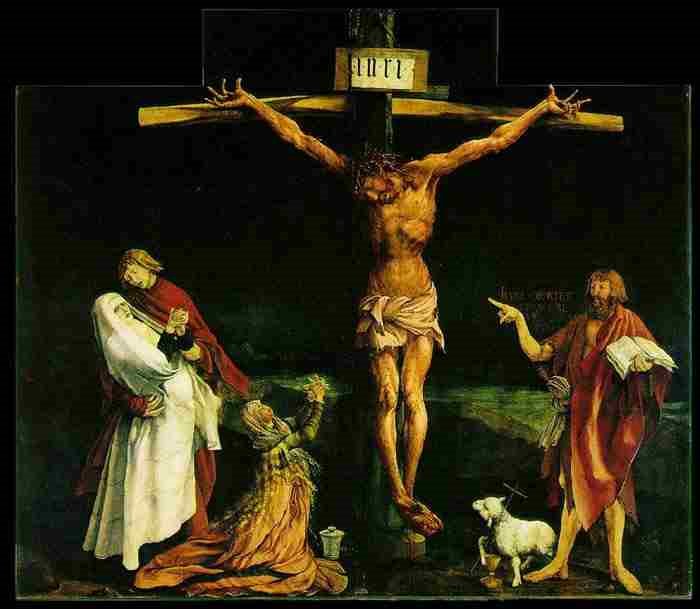
This afternoon, when Wood showed us the Grunewald painting above, someone made a remark about John the Baptist (on the right, pointing) being present in it. I appreciated Wood's response: "Holy time is not chronological time." Wood had just finished talking about the importance of the church calendar to our lives.

Here are some musings based on what Wood said: We need a way of shaping our view of time that is free from the demands of the fiscal year, work year, etc. In the end, what we do in worship is "useless" according to the world's (I mean world in the way John the Revelator used it) understanding. We need something to remind us that work and acquiring "stuff"--dare I say, even acquiring knowledge--is not our ultimate end. We need something to remind us that our Ultimate End is the enjoyment of God--the beatific vision.

Friday, April 06, 2007

Good Friday


I posted this quotation last year on Good Friday. It's worth doing it again.

God, who needs nothing, loves into existence wholly superfluous creatures in order that He may love and perfect them. He creates the universe, already foreseeing--or should we say "seeing"? there are no tenses in God--the buzzing cloud of flies about the cross, the flayed back pressed against the uneven stake, the nails driven through the mesial nerves, the repeated incipient suffocation as the body droops, the repeated torture of back and arms as it is time after time, for breath's sake, hitched up. If I may dare the biological image, God is a "host" who deliberately creates His own parasites; causes us to be that we may exploit and "take advantage of" Him. Herein is love. This is the diagram of Love Himself, the inventor of all loves. C.S. Lewis

Monday, February 19, 2007

On Lenten hiatus


For what it's worth. Here is a post I wrote last year at the beginning of Lent.

Saturday, February 03, 2007

The Presentation of Our Lord


I forgot to post this yesterday...February 2nd is the day that Christians for centuries have remembered Christ's presentation at the temple i.e. The Presentation of Our Lord. At his presentation, sacrifices were made for Mary's purification and for Mary and Joseph's first born son. Thus, Christ, from the very beginning, has come to fulfill the Law. Also, at the presentation, a man waiting for the coming Messiah, Simeon, held the Christ child in his arms. The one through whom all things were made was held by one of his creations. Immanuel, God is with us!

I spoke about The Presentation in chapel on Thursday to my school's lower grades. Afterward, one first grade teacher jokingly reminded me that February 2nd is also Groundhog Day. We both had a lighthearted chuckle at this fact and went about our days. However, as I thought about it later, her observation did once again remind me of the importance of the church calendar. We have many other calendars--fiscal, academic and otherwise--competing for our attention, and most institutions recognize the easily overlooked fact that we live in time. Thus, they restructure their calendars--the time constraints within which they must function--based on what their corporate bodies are centered upon. Thus, financiers have their fiscal calendars, schools their academic ones, and so on.

The Church's calendar is restructured to be centered upon the Word made flesh--the One who is our access to the End of all things. By living with and by the church calendar throughout the year, we are acknowledging that the other calendars we must live by during our day-to-day lives are not the ultimate way we interpret time. Ultimately, our interpretation of time does not have at its center money, academics, etc. The Church's way of living in time--i.e. its calendar--has Christ at its center. The church calendar tells the story of Christ, sin, and redemption beginning every Advent season. As I am more and more convinced that it's the stories we live by that shape the way we reason about things and feel about our experiences, what better way to keep the story of "the way things are" in our imaginations and hearts than by living through it each year. We can have six more weeks of winter as long as the Messiah has come to us.

Read more about the Presentation of Our Lord.

Sunday, June 04, 2006

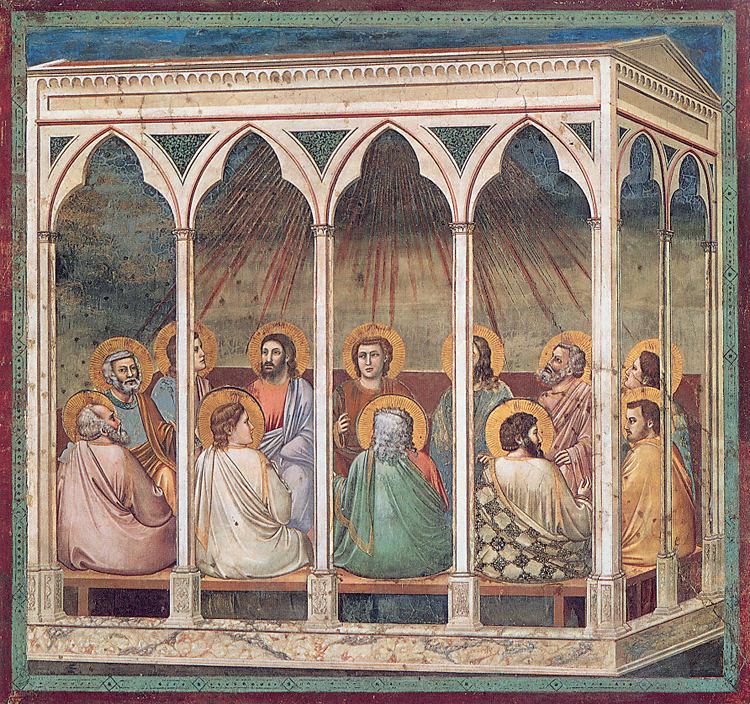
Pentecost


From The Daily Gospel:

Saint Anthony of Padua (around 1195 – 1231), Franciscan, Doctor of the Church.
"Sermons for Sundays and the Feasts of the Saints"

Tongues as of fire appeared.” Tongues – those of the serpent, of Eve and Adam, had given death access to this world… That is why the Spirit appeared in the form of tongues, opposing tongues with tongues, healing the fatal poison by means of fire… “They began to speak.” That is the sign of fullness; the full vessel overflows; the fire cannot contain itself… These diverse tongues are the various lessons that Christ left us, such as humility, poverty, patience, obedience. We speak in these various tongues when we give our neighbor an example of these virtues. The word is alive when the works speak. Let us make our works speak!

Friday, April 14, 2006

Good Friday


God, who needs nothing, loves into existence wholly superfluous creatures in order that He may love and perfect them. He creates the universe, already foreseeing--or should we say "seeing"? there are no tenses in God--the buzzing cloud of flies about the cross, the flayed back pressed against the uneven stake, the nails driven through the mesial nerves, the repeated incipient suffocation as the body droops, the repeated torture of back and arms as it is time after time, for breath's sake, hitched up. If I may dare the biological image, God is a "host" who deliberately creates His own parasites; causes us to be that we may exploit and "take advantage of" Him. Herein is love. This is the diagram of Love Himself, the inventor of all loves. -- C.S. Lewis

Thursday, April 13, 2006

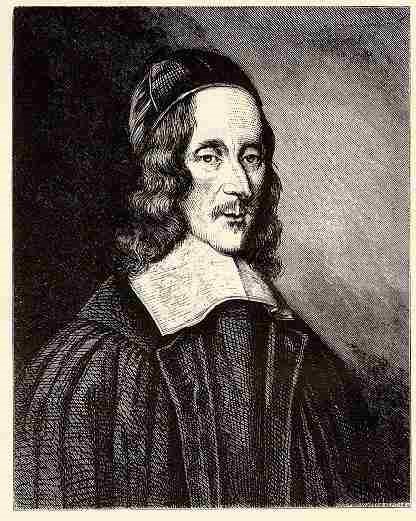
George Herbert's "The Sacrifice"


Anthony Esolen posted this today at the Mere Comments blog. It's a very good poem and by the author who wrote the poem from which the name of this blog comes.

....My cross I bear myself, until I faint:
Then Simon bears it for me by constraint,
The decreed burden of each mortal Saint:
Was ever grief like mine?

O all ye who pass by, behold and see:
Man stole the fruit, but I must climb the tree;
The tree of life to all, but only me:
Was ever grief like mine?....

Lo, here I hang, charged with a world of sin,
The greater world o' th' two; for that came in
By words, but this by sorrow I must win:
Was ever grief like mine?....

But, O my God, my God! why leav'st thou me,
The son, in whom thou dost delight to be?
My God, my God ----
Never was grief like mine.

From George Herbert, "The Sacrifice" (1633)

Maundy Thursday: The Institution of the Eucharist

This is an appropriate quotation from C.S. Lewis for today, Maundy Thursday:

"I do not know and can't imagine what the disciples understood Our Lord to mean when, His body still unbroken and His blood unshed, He handed them the bread and wine, saying they were His body and blood...I find no difficulty in believing that the veil between the worlds [heaven and earth], nowhere else (for me) opaque to the intellect, is nowhere else so thin and permeable to divine operation. Here a hand in the hidden country touches not ony my soul but my body. Here the prig, the don, the modern, in me have no privilege over the savage or the child...The command, after all, was Take, eat: not Take, understand. Particularly, I hope I need not be tormented by the question 'What is this?'--this wafer, this sip of wine. That has a dreadful effect on me. It invites me to take 'this' out of its holy context and regard it as an object among objects, indeed as part of nature. It is like taking a red coal out of the fire to examine it: it becomes a dead coal." (from Letters to Malcolm, Ch.19)

See the previous post (below) for another good meditation for today in the church calendar.

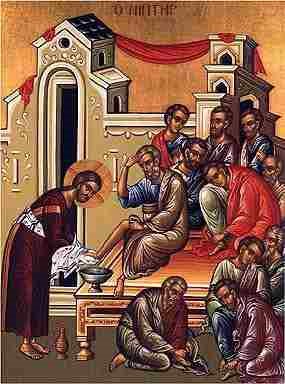
Maundy Thursday: Love One Another As I Have Loved You


Here's a wonderful meditation from Guerric of Igny (around 1080 – 1157), Cistercian abbot. 1st Sermon for Palm Sunday from www.dailygospel.org

“He had loved his own in this world, and would show his love for them to the end.”“Your attitude must be that of Christ.” … “He was in the form of God,” equal to God by nature, since he shared in God’s power, God’s eternity and God’s very being… He did the job of a servant “by humbling himself, obeying his Father even to death, death on a cross.” (cf. Phil 2:5-8) One might consider it to be trivial that, as God’s Son and his equal, he served his Father as a servant. More than that, he served his own servant more than any other servant. For the human being had been created to serve his Creator. What could be more just for you than to serve him who made you, without whom you would not be? And what could be more blest than to serve him, since to serve him is to reign? But the human being said to his Creator: “I will not serve.” (Jer 2:20)Then the Creator said to the human being: “So I will serve you! Go sit down at the table; I will serve. I will wash your feet. Rest. I will take your pains upon myself; I will carry your weakness… If you grow tired or are burdened, I will carry you, you and your burden, so as to be the first to fulfill my law: ‘Carry one another’s burdens’ (Gal 6:2)… If you are hungry or thirsty…, here I am, ready to be sacrificed so that you might eat my flesh and drink my blood… If you are taken into captivity or if you are sold, here I am… Redeem yourself by paying the ransom you will get from me. I give myself as ransom… If you are sick, if you fear death, I will die in your place, so that from my blood you can make for yourself a life-giving remedy…”O my Lord, what a price you paid to ransom my useless service!… What a way you had, full of love, of gentleness and of kindness, to win back and submit this rebellious servant by triumphing over evil through good, by confounding my pride with your humility, by filling this ungrateful person with your kindness! This! This is how your wisdom triumphed.

Wednesday, April 12, 2006

Collect for Wednesday


This is the collect* for Wednesday of Holy Week taken from the Book of Common Prayer:

O Lord God, whose blessed Son our Savior gave his back to the smiters and hid not his face from shame: Grant us grace to take joyfully the sufferings of the present time, in full assurance of the glory that shall be revealed; through the same thy Son Jesus Christ our Lord, who liveth and reigneth with thee and the Holy Spirit, one God, for ever and ever. Amen.

* Collect: From the Latin word collecta, meaning "assembly." The word is normally used to refer to the prayer near the beginning of the Eucharist that precedes the lessons. The collect was supposedly designed to "collect" the thoughts of the lessons and bind the thoughts together, back in the days when only one lesson and a Gospel were read. A collect is actually any short prayer that contains an invocation, a petition, and a pleading in Christ's Name (in that order).
(You can find more Episcopalian/Anglican terms at http://www.holycross.net/anonline.htm)

Tuesday, April 11, 2006

St. Peter and Language

I started receiving this email called The Daily Gospel. It's quite good. It always has a commentary from an early church writer, father, doctor, etc. included at the end.
The gospel reading for today is from John 13.21-38. Can't we all identify with Peter?

Commentary of the day : Saint Maxim of Turin (? – around 420), Bishop CC Sermon 76, 317

“The cock will not crow before you have three times disowned me.Turning around, the Lord looked at Peter. And Peter, become aware of what he had just said, he repented and wept…; he broke into tears and remained mute… (cf. Lk 22:61-62). Words can not be successful in expressing a prayer, and they can never succeed in expressing tears. Tears always express what we are feeling, but words can be powerless. That is why Peter did not have recourse to words. Words had pushed him to betray, to sin, to deny his faith. He preferred admitting his sin by means of tears, since he had denied through words…Let us imitate him in what he said elsewhere, when the Lord asked him three times: “Simon, do you love me?” (Jn 21:17) Three times he answered: “Lord, you know that I love you.” Then the Lord said to him: “Feed my sheep,” and he said it three times. That word made up for his previous aberration. The one who had denied the Lord three times, confessed him three times; he had become guilty three times, three times he obtained grace through his love. See therefore what benefit Peter drew from his tears!… Before shedding tears, he was a traitor; once he had shed tears, he was chosen as pastor, and he who had behaved badly received the responsibility to lead the others.

Monday, April 10, 2006

Lazarus Saturday

Here's a good meditation on Lazarus Saturday (the day before Palm Sunday--I just discovered that it was called this, at least in the Orthodox calendar). It's by James Kushiner of Touchstone Magazine. Here's an excerpt:

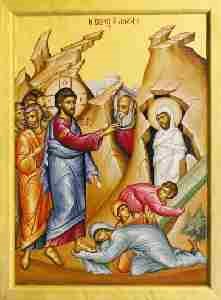
One of my most memorable Lents was spent reading Crime and Punishment, so the crime theme was close at hand. What brings me back to that Lent, which was perhaps five years ago, is reading today [two days ago] from the Lenten Triodion of the Orthodox Church. I am reading verses for Lazarus Saturday, which falls next Saturday and marks the place where Lent ends and Holy Week begins.

Of course in the Western calendar today is the day before Palm Sunday, and readings from John 11 on the raising of Lazarus make sense. According to John, Jesus' return to Bethany and the raising of Lazarus marks the beginning of his passion sequence. When the leaders saw how the crowds, who were arriving in Jerusalem for the Passover, responded to the news of Lazarus's resurrection, they knew trouble was brewing. Next thing you know they might hail Jesus as Messiah, which, of course they did on Palm Sunday.

Crime and Punishment, of course, brings the raising of Lazarus quietly into the novel as it unfolds in the redemption of the hopeless murderer Raskolnikov. I cannot approach Lazarus Saturday without thinking of the redemption of that wretched man.

Sunday, March 19, 2006

Fr. Alexander Schmemann on Easter

St. Paul says: "If Christ is not risen, then your faith is in vain." There is nothing else to believe. This is the real center, and it is only in reference to Easter as the end of all natural time and the beginning of the new time in which we as Christians have to live that we can understand the whole liturgical year. If you open a calendar, you will find all our Sundays are called Sundays after Pentecost, and Pentecost itself is fifty days after Easter. Pentecost is the fulfillment of Easter. Christ ascended into heaven and sent down His Holy Spirit. When He sent down His Holy Spirit into the world, a new society was instituted, a body of people, whose life, though it remained of this world and was shared in its life, took on a new meaning. This new meaning comes directly from Christ’s Resurrection. We are no longer people who are living in time as in a meaningless process, which makes us first old and then ends in our disappearance. We are given not only a new meaning in life, but even death itself has acquired a new significance. In the Troparion at Easter we say, "He trampled down death by death." We do not say that He trampled down death by the Resurrection, but by death.

A Christian still faces death as a decomposition of the body, as an end; yet in Christ, in the Church, because of Easter, because of Pentecost, death is no longer just the end but it is the beginning also. It is not something meaningless which therefore gives a meaningless taste to all of life. Death means entering into the Easter of the Lord. This is the basic tone, the basic melody of the liturgical year of the Christian Church. Christianity is, first of all, the proclamation in this world of Christ’s Resurrection. Orthodox spirituality is paschal in its inner content, and the real content of the Church life is joy. We speak of feasts; the feast is the expression of joyfulness of Christianity.

Fr. Schmemann was an Russian Orthodox theologian who lived in the U.S. You can find out more about Fr. Alexander Schmemann here and here (this links to an obituary).

Wednesday, March 01, 2006

Lent, Protestant Evangelicals, and Time

Here is a quotation from D.H. Williams, an ordained Baptist pastor who taught for many years at The University of Chicago (Catholic), regarding Tradition/Church history and the Holy Spirit:

"It is time for Protestant evangelicals to reconsider much more seriously the work of the Holy Spirit in the whole history of the church. This will mean that we will understand the ministry of the Spirit not as a privately emerging force in individuals as much as the primary Actor in the church's actus tradendi, the living transmission and acceptance of the apostolic message in the body of Christ. It is through this corporate and 'horizontal' process that our individual ('vertical') encounter with the Holy Spirit is shaped and nurtured. Following the way of discipleship cannot function as Christian discipleship in isolation from the guidance which the Spirit has provided through Spirit-led men and women in the church's past. A dizzying array of options are available for anyone who seeks privatized or small group spirituality, and some of these closely mimic Christianity. But only through Scripture and the consensual Tradition will the believer be enabled to find spiritual living that is within the shelter of the orthodox faith of the church" (from Retrieving the Tradition and Renewing Evangelicalism: A Primer for Suspicious Protestants, pp. 69-70, boldtype mine).

I am including this quotation in today's post because, of course, today is the beginning of the Lenten season. And historically, Protestants, being those who tend toward suspicion when it comes to tradition, often make little of seasons like Lent--seeing them as vestiges of a Catholic-dominated past from which we wish to escape. But we were created in time (see Gen. 1--"seasons" come before the creation of man) and seasons are helpful to us. We, however, live in a culture that attempts (largely due to consumeristic agendas, etc.) to smear the distinctions between times and seasons (24hr. businesses, and so on). Nevertheless, we cannot escape our creaturehood, and it seems to me that the more we attempt to live apart from creation and reject the undulation of time and the necessity of seasons, the worse off we are.

Here's a link to a helpful guide for Lent from Christ Church (Episcopal) in Plano, TX.