Showing posts with label Sacramental Knowledge. Show all posts

Monday, August 07, 2006

Leithart on Why Evangelical's Can't Write

The most recent edition of Credenda Agenda is chiefly about Flannery O'Connor. An article that struck me the most was Peter Leithart's Why Evangelical's Can't Write. His thesis:

Here is a thesis, which I offer in a gleeful fit of reductionism: Modern Protestants can't write because we have no sacramental theology. Protestants will learn to write when we have reckoned with the tragic results of Marburg, and have exorcised the ghost of Zwingli from our poetics. Protestants need not give up our Protestantism to do this, as there are abundant sacramental resources within our own tradition. But contemporary Protestants do need to give up the instinctive anti-sacramentalism that infects so much of Protestantism, especially American Protestantism.

The reference above to Marburg is there because Leithart opens his article with the 1529 Colloquy at Marburg where Zwinglians and Lutherans met to debate and come to an agreement on Luther's doctrine of the real presence in the Eucharist. After agreeing to fourteen of the fifteen propositions put forth by Luther, the Zwinglians--once they were home, after the colloquy--took up the cudgels once again for the Eucharist as mere memorial and the Lutherans once again fought back with their real presence position.
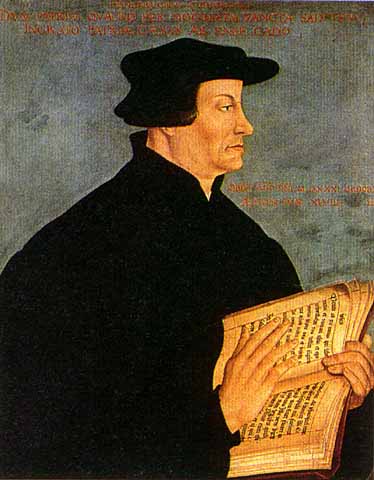
Leithart's argument for why evangelicals can't write goes back to this historical occasion. When the Zwinglians and Lutherans finally parted ways for good at the Diet of Augsburg in 1530, the Protestant mind would forever be influenced by the rift:

Marburg is important not so much for what it achieved but as a symbol of what it failed to achieve. It provides a symbolic marker not only for the parting of the ways between Lutheran and Zwinglian, but also, for Zwinglians, the final parting of the ways between symbol and reality. J. P. Singh Uberoi claimed that "Spirit, word and sign had finally parted company at Marburg in 1529. For centuries, Christian sacramental theology had held symbol and reality together in an unsteady tension, but that alliance was ruptured by the Zwinglian view of the real presence. For Zwingli, "myth or ritual . . . was no longer literally and symbolically real and true." In short, "Zwingli was the chief architect of the new schism and . . . Europe and the world followed Zwingli in the event."
For many post-Marburg Protestants, literal truth is over here, while symbols drift off in another direction. At best, they live in adjoining rooms; at worst, in widely separated neighborhoods, and they definitely inhabit different academic departments.


Friday, July 28, 2006

Marriage is a Kind of Death

I thought I would continue my posts on family/marriage. I found this article from Touchstone magazine today while perusing Park Cities Presbyterian's website. Peter Leithart from New St. Andrew's College in Moscow, ID wrote a wise and much needed article on marriage where he quotes Alexander Schmemann. The article's central theme is that marriage is a kind of death--but good death. Here's how Leithart closes out the article:

Nearly four decades ago, Alexander Schmemann argued that the problem with modern marriage "is not adultery or lack of ‘adjustment’ or ‘mental cruelty.’" Instead, he wrote, the problem is the "idolization of the family" that identifies "marriage with happiness" and refuses "to accept the cross in it." God’s presence as a "third party" in the marriage spells "the death of the marriage as something only ‘natural,’ and directs it to its true end of the kingdom of God.

In short, Schmemann continued, with characteristic elegance, the glory of marriage is "that of the martyr’s crown. For the way to the Kingdom is the matyria: bearing witness to Christ. And this means crucifixion and suffering. A marriage that does not constantly crucify its own selfishness and self-sufficiency, which does not ‘die to itself’ that it may point beyond itself, is not a Christian marriage."

Wednesday, April 26, 2006

Christianity and the Arts

I have been leading a class at my church through C.S. Lewis' Screwtape Letters. I found this short article called "TheImportance of the Arts to Christianity" by Louis Markos. It's very insightful. Markos is a Lewisian, and I found it here. Here it is:

THE IMPORTANCE OF THE ARTS TO CHRISTIANITY

by Louis Markos, Houston Baptist University

1. Through a proper use of the arts, we must heal the enlightenment split between religion and science, art and technology, values and facts, myth and history, fiction and fact, emotional and rational, intuition and logic, revelation and reason, secular and sacred, poetry and doctrine. We need a re-synthesis, one that will allow us to worship God with our minds and hearts. We need to use the arts to heal what T. S. Eliot called “the dissociation of sensibility” that set in c. 1800. A proper use of the arts may even help us to re-integrate the modern Christian divide between a too-rigid focus on systematic theology and an overly-emotional emphasis on spiritual gifts.

2. We need the arts to make Christian theology come real. Art comes closer than systematic theology at expressing and capturing the mystery inherent in the Trinity. Art, in bringing together the abstract and the particular, the universal and the concrete points to the Incarnation—the central belief that Jesus was FULLY Man and FULLY God. We can learn from the Eastern Orthodox focus on icons as proclaimers of the Word made Flesh. The Incarnation baptized physical matter as a fit receptacle for divine meaning and presence. We need not be iconoclasts or fear representations of holy subjects (as do the Muslims and as did the Jews)

3. The producing, absorbing, and interpreting of the arts exercises the mind to under-stand the many levels of meaning in Scripture. Augustine and Aquinas both felt that God purposely made the Bible difficult so that we would have to wrestle with it (Bible is not stream-lined, not all slick packaging). A full wrestling with the arts and the stories that underlie them helps us to perceive and to engage sacred history. It helps us to see and understand that God works THROUGH history; Bible is mostly told from man’s perspective. (Dream of the Giant; Dante forces us to learn history.)

4. We must be salt and light in the world; we must engage our culture through the arts. The arts speak to people on a deep level; they form people’s opinions and attitudes in a way that is often not seen. The battle is often won through images, for it is around images that people often hang their beliefs and goals. The influence of rap, heavy metal and MTV is far more harmful than anyone gives it credit for.

5. The arts are vital to the artist, for we MUST use our gifts (Matt 25). Even if no one reads/hears our work, through the very fact that we produced it, we praise God. We must strive for excellence—not just be good enough to sing on Sunday morning.

6. The arts help us to perceive and/or build connections everywhere. By so doing, they allow us: a) to rebuild the sympathetic universe that the medievals saw and that Dante embodied most fully; 2) to see that Christ fulfills not only the Jewish Law/Prophets but all the deepest philosophical, theological, and aesthetic yearnings of mankind; 3) to be better evangelists and apologists through an ability to re-incarnate the Gospel in a variety of different cultures; 4) to praise God through a symphony of voices.

Louis Markos, Houston Baptist Univ., lmarkos@hbu.edu,

http://fc.hbu.edu/~lmarkos

Thursday, April 20, 2006

Another from The Daily Gospel

The early church doctors' and fathers' poetic understanding of Scripture and salvation history is beautiful:

Commentary of the day : Saint Peter Chrysologus (around 406 – 450), Bishop of Ravenna, Doctor of the Church Sermon 81

“Jesus came and stood before them. ‘Peace be with you.’”

Rebellious people had chased peace from the earth… and thrown the world into its primordial chaos… Among the disciples as well, war was waging; faith and doubt fought furious assaults on one another… Where a storm was raging, their hearts could find no peaceful harbor, no calm port. At the sight of that, Christ, who plumbs the hearts, who commands the winds, who is master over the tempests and who with a simple sign changes the storm into a serene sky, strengthened them with his peace, saying: “Peace be with you! It is I; fear not. It is I who was crucified, who was dead, who was buried. It is I, your God become man for you. It is I. Not a spirit clothed with a body, but truth itself become man. It is I, the living one among the dead, who have come from heaven to the heart of hell. It is I before whom death fled, whom hell feared. In its terror, hell proclaimed me to be God. Do not be afraid, Peter, you who denied me, nor you, John, who fled, nor all of you who abandoned me, who thought of nothing but betraying me, who do not yet believe in me, even though you see me. Do not be afraid, it really is I. I have called you with grace, I have chosen you with forgiveness, I have upheld you with my compassion, I have carried you in my love, and I am taking you today solely because of my kindness.”