Showing posts with label Popular Culture. Show all posts

Wednesday, January 28, 2009

A Quick Evaluation of Benjamin Button

Spoiler Alert: This post contains details pertaining to the film The Curious Case of Benjamin Button.

I haven't been able to get out and see many of the films that have been nominated for the Academy Award's "Best Picture," but Jana and I were able recently to drop the little one off at the folks so we could go watch The Curious Case of Benjamin Button. We wanted to see Slumdog Millionaire, but it was not showing in the part of town we were visiting, so we settled for Benjamin Button.

I have read various judgments of the Academy's nominations and many of them have been highly critical--including this one. I have to say, after seeing Benjamin Button, I tend agree with these nay-sayers.

The main problem with film--besides the fact that its been done before (see Forrest Gump)--is that Benjamin is so uninteresting. He doesn't change. Actually, I take that back: he does change, but the change is only skin deep--quite literally. He goes from ancient-ugly-infant to a weird A River Runs Through It Brad Pitt to adolescent-trying-figure-himself-out to cuter infant. But that's it. He's a manchild all the way through and static; his co-star Cate Blanchett's character (i.e. Benjamin's "Jen-nay") is more interesting with her moving to New York, talking about D.H. Lawrence, and having a career-ending accident. Her struggle is more internal, and she seems a bit more complex and therefore, interesting.

Also, I am not sure why Hurricane Katrina in the frame story is so important. Is it there simply for context--to let us know that the frame story takes place in recent years? Fine. But when the waters from the broken levees begin to flood the basement where the clock, which is so central to the story, is stored, you being to think Katrina is supposed to represent something more than just a backdrop to the present-day story.

I am not always this critical of the Academy. I was pleased with No Country for Old Men's selection last year. But then again, there have been other years when the Best Picture went to more mediocre fare.

Thursday, July 05, 2007

Once


Pseudo Spoiler Alert: I am writing about the movie Once below. I don't give away the ending but I do try to enter into the plot a little to provide some insight into the film. I don't think I give awaytoo much, but you may be really fastidious about what you do and do not know about a film before you see it.

There is a film that is out now that would be worth your seeing: Once. It's a lovely film about a man and a woman and their mutual love for music. The movie is, in fact, a musical of sorts--not the Sound of Music type but a new kind. The characters, played by Glen Hansard (of the Irish rock band The Frames) and Marketa Irglova (who has recently recorded an album with Hansard under the title The Swell Season which contains some of the songs from the movie), tell the story through songs--most of which were composed by Hansard.
What I liked most about the film was the way the music acts as a medium through which the characters approach each other. To paraphrase Wendy Shalit from her 1999 book A Return to Modesty, there was a time when it was widely considered necessarily sexual for a man and woman to simply be alone in a room together. There are plenty of scenes where the two main characters are alone and yet their music (along with a couple of other important checks) acts as a mediator, allowing them to transcend their raw (albeit good) desires for companionship. The music also is the thing that gives the movie an unfulfilling---yet at the same time, fulfilling--ending. I don't want to spoil the whole thing for any of you interested in seeing Once, so please go watch it to see if I'm on to anything.

Saturday, April 28, 2007

Before Joe Camel...


Before the days of Joe Camel, there was Fred Flintstone. Seriously. Watch this.

Tuesday, February 13, 2007

Cavemen


In the interest of bringing a little levity to this blog, I thought I might post a link to a favorite commercial of mine.

Saturday, February 03, 2007

The Making of a Commercial

I forgot to add this to my post from yesterday. Comes from JT's blog again...the making of that Sony commercial mentioned in yesterday's post is here. It's pretty amazing.

Friday, February 02, 2007

Do you know Jose Gonzalez?

I found this link at my friend JT's blog Exit 78 (BTW: Jt's blog is primarily a photo blog with some nice shots on it). This is a commercial for the Sony Bravia TV using Jose Gonzalez's cover of a song entitled "Heartbeats" (by a Swedish group called The Knife?). This is footage of Jose Gonzalez performing "Heartbeats" live. I haven't heard of this guy before, but I like this song. Very nice and melodic.

You can find Jose Gonzalez's MySpace Music page here.

Monday, January 29, 2007

Saturday, January 27, 2007

Sean Michel: The Next American Idol


About a week ago, I saw an advertisement on TV for the upcoming episode of American Idol. As the images were flashing by, I thought I caught a glimpse of a guy I knew from college named Sean Michel auditioning there in front of Simon, Paula, and Randy. And wouldn't you know, sho' nuff, it is he. I'm a big fan of his beard and he sang Johnny Cash's "God's Gonna Cut You Down." What more could you ask for? GO SEAN! You're going to Hollywood dawg!


Watch the audition here.


Here's another link.

Saturday, January 20, 2007

The Right Not to Know


A few posts back, I quoted Alexander Solzhenitsyn at length on politics and the perils of having a society dominated by only the legal level of reality. I found this interesting article which highlights another part of the Soviet Russian exile's 1978 Harvard commencement address. The writer of the article, Darryl E. Owens, makes the claim that the media is doing a lot to encroach upon our right to privacy. Here's a sample:

Once, some things were private. But today unmentionables routinely are aired on The Today Show.
But the practice seems all the more disturbing in a case like Shawn's, yet another reminder of America's schizophrenic mind-set.
In a day when Big Brother eavesdrops on our chats, satellites can read our tattoos, and our most private moments can earn a very public airing on the World Wide Web, we vociferously bemoan our withering privacy.At the same time, an insatiable, vaguely prurient curiosity has yanked down the veil that once cloaked private life from the searing public eye and replaced it with a clear curtain.

The "Shawn" mentioned above is the Shawn Hornbeck--the now young man who was abducted four years ago in Missouri. Owens is critical of Oprah Winfrey's having Hornbeck and his parents on her show just days after his being rescued, asking the boy himself if he had been sexually abused. After Shawn opted not to talk about his experience, Oprah went to his parents--she "went there"--and asked if they believed Shawn had been abused.

As America hung on every word, the parents of the Missouri boy looked the Queen of All Media in the eye, slowly bobbled their heads, and answered, "Yes."Yes, indeed. After all, wasn't that the burning question that inquiring minds wanted to know? Isn't it what we deserved to know?

It's this right to know that bothers Owens, me, and Alexander Solzhentisyn. Don't we have the right not to know, and doesn't Shawn Hornbeck have the right not to relive a painful experience on national television. Here are Solzhenitsyns' thoughts:

Because instant and credible information has to be given [ in the media], it becomes necessary to resort to guesswork, rumors and suppositions to fill in the voids, and none of them will ever be rectified, they will stay on in the readers' memory. How many hasty, immature, superficial and misleading judgments are expressed every day, confusing readers, without any verification. The press can both simulate public opinion and miseducate it. Thus we may see terrorists heroized, or secret matters, pertaining to one's nation's defense, publicly revealed, or we may witness shameless intrusion on the privacy of well-known people under the slogan: "everyone is entitled to know everything." But this is a false slogan, characteristic of a false era: people also have the right not to know, and it is a much more valuable one. The right not to have their divine souls stuffed with gossip, nonsense, vain talk. A person who works and leads a meaningful life does not need this excessive burdening flow of information.

One must wonder if Oprah and other journalists who are so quick to nab the story and get the scoop think of what they're doing in these cases as "gossip, nonsense, [and/or] vain talk." I think Oprah probably has good intentions, but you know what they say about those.

Friday, January 05, 2007

Solzhenitsyn and Politics

As I implied in a post months back, one of the reasons I tend to steer clear of politics is best summed up by Alexander Solzhenitsyn in his 1978 Harvard commencement address. There, he warns against understanding reality in a purely legal way. That is, the legal level of reality becomes the predominant one, thus pushing the religious and spiritual levels to the fringes. And, as long as you are right according to "the letter of the law," no other considerations need to be examined. Here are his words:

People in the West have acquired considerable skill in using, interpreting and manipulating law, even though laws tend to be too complicated for an average person to understand without the help of an expert. Any conflict is solved according to the letter of the law and this is considered to be the supreme solution. If one is right from a legal point of view, nothing more is required, nobody may mention that one could still not be entirely right, and urge self-restraint, a willingness to renounce such legal rights, sacrifice and selfless risk: it would sound simply absurd. One almost never sees voluntary self-restraint. Everybody operates at the extreme limit of those legal frames. An oil company is legally blameless when it purchases an invention of a new type of energy in order to prevent its use. A food product manufacturer is legally blameless when he poisons his produce to make it last longer: after all, people are free not to buy it.

I have spent all my life under a communist regime and I will tell you that a society without any objective legal scale is a terrible one indeed. But a society with no other scale but the legal one is not quite worthy of man either. A society which is based on the letter of the law and never reaches any higher is taking very scarce advantage of the high level of human possibilities. The letter of the law is too cold and formal to have a beneficial influence on society. Whenever the tissue of life is woven of legalistic relations, there is an atmosphere of moral mediocrity, paralyzing man's noblest impulses.
Throughout the rest of the speech, Solzhenitsyn continues to call for "voluntary self-restraint" as the way to save society from the mediocrity he mentions above. In a society governed by the rule of law, there must be sacrifice and temperance. Societies governed by an "objective legal scale" are indeed great, but do we dare to continue to promote such societies if all moral or religious law is forced out of the public sphere? Out of all discussions regarding public life?

Sunday, December 31, 2006

Thank God for the Language Police

Language is powerful. Without its mediating role, we would be unable to grasp reality. Did you know there was a Language Police out there? Someone needed to do it. Words are misused, overused and a-bused here in the Information Age. Lake Superior State University has been compiling a list of banned words worn slick with overuse for the past thirty years. I think the official list comes out tomorrow. You can read about it here as well.

Friday, December 22, 2006

Here's What I Want For Christmas...


I want the Giant Swiss Army Knife. Just think of the jams MacGyver could have gotten out of with this beast. You can read more abou tthe Giant below or read the full story here.

Just as you can't be too rich or too thin, I'd always thought, so you can't have too many tools on your Swiss Army knife - but that was before I took delivery of the new Giant Swiss Army knife. Grotesque, if superbly engineered, the Giant weighs nearly a kilogram and features 85 devices in all. Unload this mother into the plastic tray as you walk through security at Heathrow and just see what happens.

The Giant is supposed to feature every blade that has ever been incorporated into Swiss Army knives as made by Wenger, one of the two firms that make them . "We've sold 20 to retailers so far, and we can't get them in fast enough," says Garry Woodhouse of Whitby and Co, sole importer of Wenger knives into Britain. "They're assembled by hand in Switzerland, and I'm told that the man doing it is working his fingers to the bone."

Monday, November 20, 2006

Young people in developed countries unhappy, survey says

Found this interesting piece tonight. Here's one provocative line from the article:

"The happier young people of the developing world are also the most religious," the survey said.

I recently read Alexander Solzhenitsyn's 1978 Harvard Address with a group of students at school. There are some real resonances between his words and what has apparently been discovered through this study.

Sunday, September 03, 2006

Hurt

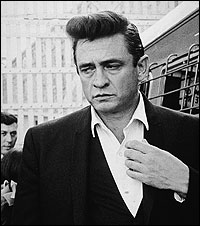
I pulled out my guitar tonight to strum a little. I was trying to figure out this one chord (I'm still pretty much an amateur after ten years of wielding my axe) in Johnny Cash's cover of Sting's "I Hung My Head". I found a site that provided the chord. I thought I was right: It was the D Minor I kept missing. As I perused the other songs, I found a link to the "Hurt" video--the one in which Cash covers the Nine Inch Nails song. I had never seen the video before; I had only heard about it. I was moved to tears...the juxtaposed footage of the young, confident Cash with the old, ailing Cash; his "House of Cash" museum--his "empire of dirt"--sitting vacant.

I think what moves me so much in Cash's music is his insistence upon the fact that one cannot escape the consequences of his actions (this is especially important in a culture where celebrity ethics are dominant--you know: you can cheat, steal, and sleep around, but you always have an out with the creation of a new image). It's apparent in "Hurt" and also in a song like "Delia's Gone." The tone of "Delia" is lighter than its content. The song is about the narrator's paying a visit to his lover in Memphis who's "low down and trifling/ And [...] cold and mean." After binding her to a chair, he shoots her in cold blood. The mood that the tune creates laid along side of the mood created by the words is chilling. Nevertheless, the murder isn't glorified in any sense. In his jail cell, the narrator sings, "But jailer, oh, jailer/ Jailer, I can't sleep/ 'Cause all around my bedside/ I hear the patter of Delia's feet." The song ends with this lesson: "So if you woman's devilish/ You can let her run/ Or you can bring her down/ and do her Like Delia got done/ Delia's gone, one more round/ Delia's gone."

However, this "lesson" has lost much of its effect in light of the narrator's inability to shake off the memory of his murdered lover. The dead are present in "Delia" and death is imminent in the "Hurt" video. This is the second reason I admire Cash's music. In his music, death is real but not glorified. From what I remember reading, the viewing of the "Hurt" video caused a hush to fall upon the crowd at the MTV music video awards in 2003, where Cash won for "Hurt." There is not much that can cause a hush in our culture anymore. As Christians, we are called to die to ourselves everyday. I think God knew that death would always hush the maddening crowds screaming for their rights and insistent upon their happiness above all else. Perhaps that's why he made it the means to life and perhaps that's why he calls his followers to it daily. You can click here to view Hurt.

Wednesday, June 28, 2006

Hybrid Hondas, Hybrid Fords...Hybrid Hamburgers.

"I'll have the hybrid combo that's completely meatless and tastes like chicken, beef, pork or turkey and a Diet Coke. Thanks."

Wednesday, May 17, 2006

The Da Vinci Code secret is out: critics hate it

I haven't been a very vocal critic about The Da Vinci Code: not because I am a latent fan of Dan Brown's fiction but because I have not had time to read any of it. Nevertheless, I find this article from Reuters interesting. Da Vinci has apparently gone over like a lead balloon with some critics at Cannes. Here's an excerpt:

At a screening late on Tuesday in Cannes, members of the audience laughed at the thriller's pivotal moment, and the end of the $125 million picture was greeted with stony silence.

Here's another article with these comments:

Other critics said the two and a half hour film was confusing to those who hadn't read the book.
"People were confused, there was no applause, just silence," said Margherita Ferrandino from the Italian television Rai 3.
"I have only read half the book, and then I got bored. It's terrible," she added.
"It was really disappointing. The dialogue was cheesy. The acting wasn't too bad, but the film is not as good as the book," added Lina Hamchaoui, from British radio IRN.

Tuesday, May 16, 2006

Muslims and Catholics Together

Catholic Christians in India have threatened to stage a large protest at the premiere of The Da Vinci Code and consequently have forced a temporary halt on the opening of the film. Muslims have even joined in.

In India, complaints against the film forced the government on Tuesday to put a temporary hold on the release of “The Da Vinci Code,” in order to address concerns before the film is opened to the public. Prior to the decision, several Catholic groups threatened to stage street demonstrations and even to shut down cinema halls screening the film. Joining in the call on Monday was the All-India Sunni Jamiyat-ul-Ulema, a powerful organization of Indian Islamic clerics, which promised to help Christian groups launch protests if the authorities did not ban the screening of the film. The clerics said "The Da Vinci Code" is blasphemous as it spreads lies about Jesus, who the Koran recognizes as a prophet.

You can read the rest here.

Friday, April 28, 2006

T.V.

I have an ambivalent attitude toward TV. I watched TONS of it as a kid and read little. My wife was just the opposite: she looks at me as though I'm speaking a foreign language when I begin to reminisce about my TV viewing in the '80's. At times, I hate the TV--with all its commercials and mind-numbing flickering--but then, at other times, despite the flaws it possesses as a medium, there are some things I really enjoy watching. Here's a cleverly written and insightful article expressing some of these very same sentiments. In fact, here's as snippet:

Of course, TV has always been mostly awful. “Boob tube” did not begin as an anatomical observation. The myth persists of a Golden Age of Television in the 1950s, but the blurry surviving kinescoped evidence yields a baser metal. Way back in May 1961, Newton Minow, chairman of the Federal Communications Commission, called TV “a vast wasteland.” Well, the landscape is a lot vaster 44 years later, and still wasted, but how could it not be? TV never stops any more; there’s just too much of it. In the late 1940s, a station played “The Star Spangled Banner” by 10 p.m. and signed off for the night. The citizenry rested—or read or did their bit for the baby boom. There’s not enough talent even in today’s fame-crazed United States to keep TV interesting all the time. Remember: Most books are not worth reading either. And not every play took a prize in old Athens; the relatively few that survive by no means represent the lot that did not.

And I had to include this one just because he mentions one of my favorite shows, King of the Hill...

King of the Hill dates from 1997, but it’s never had the breakout success it deserves, which may be a good thing. Fame hasn’t gone to its head, as happened with The Simpsons. (Fox routinely sacrifices Hill on Sunday evenings to the gods of interminable football games.) The series has stayed steadily on track and low-key hilarious, at once a send-up and an affirmation of red-state America values. The Hill family of Arlen, Texas, may shop at the big-box Mega-Lo Mart, but they’re TV royalty: levelheaded patriarch Hank (the anti-Homer Simpson), purveyor of propane and propane accessories; his wife, Peggy, a substitute high school teacher, sometimes of Spanish, who has to wing it after hola; and their ample, affable, and fitfully adolescent 13-year-old son, Bobby, of Tom Landry Middle School. Good people all, who deserve a more compliant world.

Thursday, March 09, 2006

Chiming in on the Anti-Crash Sentiments

DISCLAIMER: You may want to only read my "two cents worth" version and skip the rest of this. I wrote this trying to work out what the movie Crash lacked as a story. So if you want, here's my two cents worth and you can dismiss what you see below and go about your day pursuing more profitable ends: Read William Faulkner's Light in August and then see Crash (if you haven't seen it already). Faulkner's masterpiece deals with the same sociological themes but does it more masterfully and carefully.

Here's the long version:

This is a little late, but nevertheless...Crash should not have won the Oscar for best picture. The characters are flat: they're more like caricatures rather than characters. There's no action in the story. If there is, what is it? Racial tensions and bigotry? Social issues cannot carry a story. They can be part of the story--part of the characters' surroundings and can even and should contribute the story's momentum--but they cannot be the central thrust of the entire work. Something more fundamental that fuels such cultural issues must be central to make a story. Good stories grant one a sense of pleasure--even tragedies. Crash does not do this. This is why Crash--well--crashes. The poet--or director--should help us see something about reality. Crash tells me reality is simplistic and that everything works out in the end--like a 50 minute T.V. drama. The reality he is dealing is far too horizontal to be interesting: the concern for racial tensions in our culture (which is, of course, a proper and justified concern) is presented in purely sociological terms. That is why the film smacks of science and not story--the sociological outweighs dramatic action--observational realities outweigh transcendent ones. Consequently, the plot is trite and reminiscent of Grand Canyon--minus the in-your-face, predominant theme of race. Various lives come together in modern day Los Angeles and something happens. The plot is tired and old--not Grand Canyon's but Crash's. I am not the first to complain about this: I've heard it from various sources on the web.

Whoever wrote Crash could have helped his storytelling by first referring to Faulkner's Light in August. Various lives are thrown together in a small Mississippi town and something happens: and what happens reveals something not merely about race relations in 1930's Mississippi but essentially about man (his greatness, his limits, his moral defects), love, and sacrifice. These fundamental themes are at the root of dramatic problems--or, conflict. I guess that's it: Faulkner understood good stories as representing "the heart in conflict with itself." Crash has conflict, but it lacks dramatic conflict--it lacks the kind of conflict that makes you think about universals.

All I thought about after viewing Crash was the last scene: two people of different racial backgrounds are involved in a fender-bender and they each blame, and make racially-charged derogative comments at, the other. Just before this, one of the main African-American characters has just released a load of illegal Chinese immigrants from a van he has stolen. This is to be understood a good deed done by this character played by rapper Ludacris. So what's the juxtaposition of these two incidents mean? Well, I am afraid it is supposed to go something like this: "There are some advances being made out there in race relations, but then, you know, there's still a long way to go." Okay, yes, this is true in American society, but I could have gotten this moral lesson from a news story or a documentary. Art and story are supposed to show you something that you could not have seen through any other medium (this is not original to me but is from Flannery O'Connor). If drama and story are supposed to be more philosophical than history (or sociology), then we should see universals emerging through their respective forms. This emergence, however, is subtle and requires something of its audience. Some may balk at this notion, but this is what makes art so appealing. It's not math or science: one can't merely plug a formula in and see a result and then assume that he has found his answer. Art and story are more like life--there's ambiguity and consequent moral responsibility placed upon a character (and the reader or viewer!) to make particular choices about particular things. This is where drama is created, and I felt like the characters of Crash were not forced into difficult choices: it was apparent what each character was there to do in the movie. They made the choices I expected each of them to make, and there was conflict between people but little conflict was revealed as going on within people--struggles that would imply the conflict within oneself to make a choice.

The moral of this story? Read Light in August then see Crash.

Wednesday, March 08, 2006

Johnny Cash Recordings Set for Release in May

When Johnny Cash began his American Recordings with Rick Rubin in 1993, he was told that it would be a project in which he could record his songs simply--just his voice and his guitar. This is something he always wanted to do. In the early 70's, he had recorded some of the songs he knew as a boy, stories, etc. at his home in Hendersonville, TN. His son, John Carter Cash, seems to think that he shopped these to his label at the time, Columbia, to be produced, but Columbia wasn't interested. Apparently, these recordings are now set to be produced and sold beginning May 2006. The recordings will be called Personal File. If you're interested in more you can read about it here.